Street workout vs. calisthenics: what's the difference?
Calisthenics and street workout often describe the same training, but their histories differ. Discover how outdoor culture shaped a competitive sport.
In this article8
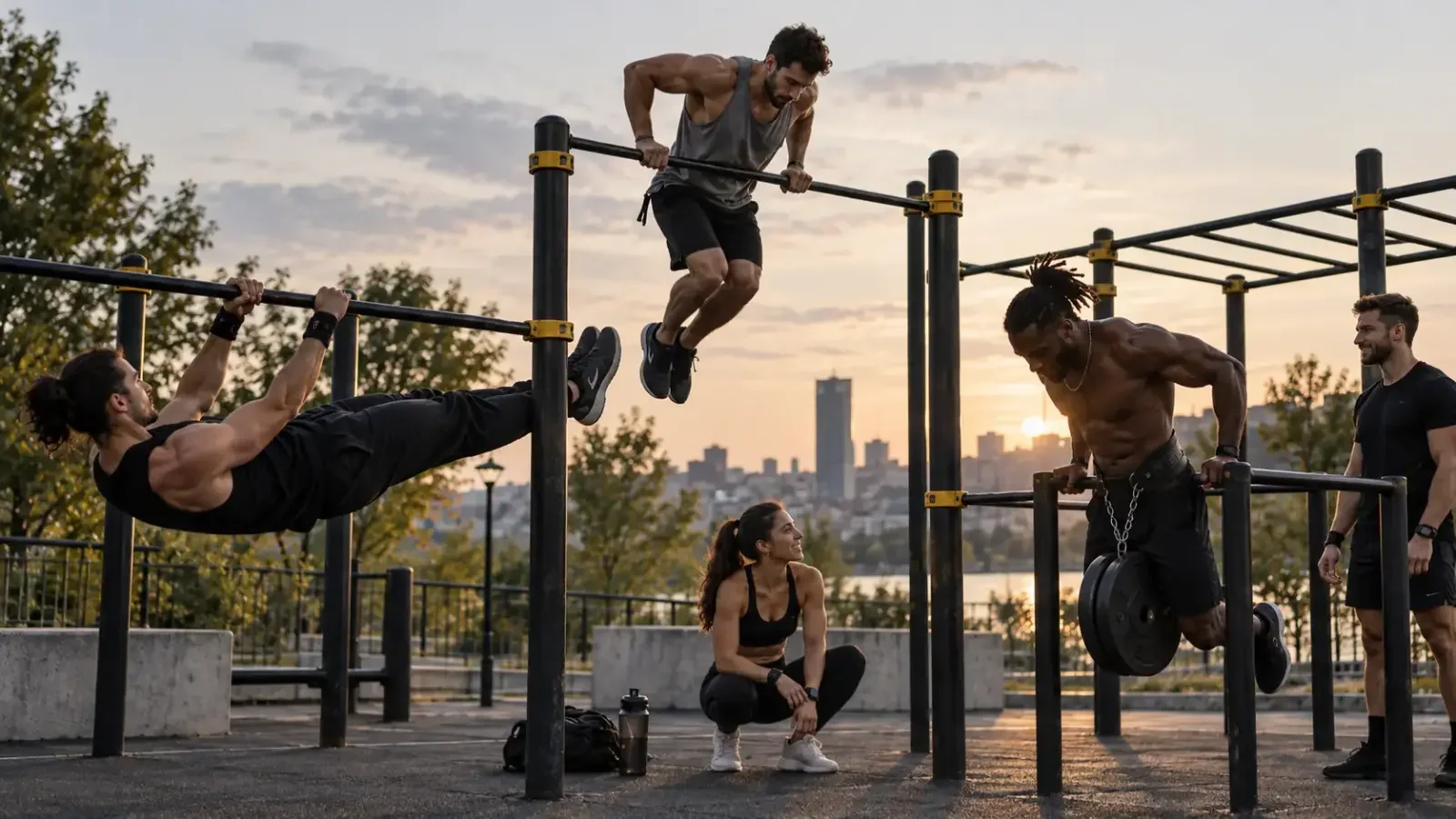
Picture two athletes training at the same outdoor park. One says they do street workout. The other says they practice calisthenics.
Both warm up on the same pull-up bar. Both work on muscle-ups. Both might spend the afternoon trying to hold a front lever.
So are they practicing two different sports, or are they using different names for essentially the same thing?
The answer involves nearly 200 years of terminology, an urban movement that spread around the world, and a competitive scene that eventually changed the name of its own world championship.
What is calisthenics?
Calisthenics is a form of physical training that uses your own body as the primary source of resistance.
Pull-ups, push-ups, dips, squats, handstands and advanced skills such as the planche are all familiar examples.
You can practice calisthenics at home, in a commercial gym or at an outdoor park. The location does not define the training.
Today, calisthenics is also widely used as an umbrella name for a broader movement that includes skills training, freestyle, endurance competitions and weighted training.
But its history goes much further back than modern pull-up parks.
A word about beauty, strength and young ladies
The word calisthenics comes from Greek roots meaning beauty (kállos) and strength (sthénos).
That does not mean calisthenics was the name of an established sport in ancient Greece. The physical exercises may have ancient predecessors, but the documented term belongs to a much more recent period.
One of the earliest surviving English references appears in Gustavus Hamilton's 1827 book, The Elements of Gymnastics for Boys, and of Calisthenics for Young Ladies.
Early calisthenics education was closely associated with posture, controlled movement and physical education for women.
That's quite a contrast with today's social media clips of athletes performing explosive combinations on horizontal bars.
The same word has travelled a remarkable distance.
What is street workout?
Street workout literally means working out in the street, although its modern meaning goes well beyond the location.
The contemporary street workout movement gained international attention during the 2000s, particularly through urban training communities, public exercise parks and online videos.
Athletes and crews began sharing increasingly advanced bodyweight skills. Videos of athletes such as Hannibal for King became influential, while communities across different countries developed their own identities and styles.
Outdoor bars became more than pieces of exercise equipment. They became meeting places where people could train, learn from one another and build friendships without necessarily joining a gym or club.
Street workout was not the invention of the pull-up. It was a cultural movement built around training, public space and community.
However, calling it only a culture overlooks an important part of its history.
Street workout was also the name of the sport
In August 2011, an international Street Workout World Championship took place in Riga, Latvia.
The competition included freestyle and power categories, official results and recognized winners. Evgeny Kozyr from Ukraine won freestyle, while Artjom Shipilo from Latvia won power.
The World Street Workout and Calisthenics Federation (WSWCF) was founded that same year.
From there, the name of the international competitive scene evolved:
- 2011: Street Workout World Championship.
- 2022: Competition regulations used Street Workout/Calisthenics together.
- 2025: The championship in Sofia, Bulgaria, was called the Calisthenics World Championship.
- 2026: Riga hosted another Calisthenics World Championship.
That timeline reveals an interesting reversal.
Although the term calisthenics is much older, the modern international competition movement initially developed under the name street workout.
The broader term eventually became a prominent name for the sport itself.
So while street workout has a distinctive urban culture, there is no historical basis for dismissing the phrase "I train street workout" as simply incorrect.
What are the different disciplines?
A useful way to understand the modern scene is to separate your training method, your main training focus and the rules of the competition you enter.
For example, an athlete might practice calisthenics, belong to a street workout community and compete in freestyle.
Common training focuses and competition formats include:
General Calisthenics: Bodyweight strength, movement control and fundamental exercises.
Skills & Statics: Advanced skills and static holds such as the planche, front lever and handstand.
Freestyle: Creative routines combining static holds, dynamic elements and transitions.
Endurance / Sets & Reps: Repetition-based training and events built around prescribed workouts or exercise counts.
Weighted Calisthenics: Traditional calisthenics movements performed with additional external weight.
Streetlifting: A related strength competition specialization, with movements and scoring determined by the organizer's rulebook.
These descriptions are useful for understanding how people train, but they are not a universal list of official competitive disciplines.
At the 2026 WSWCF World Championship, for example, athletes competed in Freestyle, Power and Endurance.
Other organizations use different classifications and rules. Even the word power can refer to a repetition-based competition with fixed additional weight rather than a one-repetition maximum.
The lesson is simple: if you're entering a competition, understand the organizer's rulebook rather than relying on the discipline's name alone.
Outdoor training is older than street workout
Public exercise spaces existed long before YouTube.
In 1811, Friedrich Ludwig Jahn established an outdoor gymnastics area at Berlin's Hasenheide, where people trained using various apparatus.
In Boston, the Charlesbank outdoor gymnasium opened in 1889, offering public exercise facilities including rings and trapezes.
Neither location was a modern street workout park in the sense we use today. But both demonstrate that public bodyweight exercise infrastructure has a much longer history than the contemporary movement.
Street workout did not invent outdoor exercise. It created a recognizable new cultural identity around it.
The Balkans are part of this history
The development of street workout and calisthenics in the Balkans offers a particularly interesting perspective.
In September 2012, Zagreb hosted a Croatian Street Workout Championship at Jarun. The event was organized with a charitable purpose, combining freestyle performance with fundraising for children with heart conditions.
In May 2015, contemporary media reported plans for what organizers described as Bosnia and Herzegovina's first national street workout championship, scheduled for Banja Luka and organized by the Bar Legion group.
More recently, Montenegro held its 11th national Street Workout & Calisthenics competition in Nikšić in October 2026, within the calendar of the country's gymnastics federation.
These events show how closely local communities, public parks, competitive sport and traditional sporting institutions have become connected.
They also show why documenting the region's history matters.
There are still unanswered questions about the earliest clubs, the first purpose-built workout parks and the people who helped local scenes grow.
Some of those stories may exist only in old photographs, archived videos and the memories of the athletes who were there.
So, is it calisthenics or street workout?
Both names have a legitimate place in today's scene.
Calisthenics generally describes the training practice and has become a prominent umbrella name for modern competitions.
Street workout emphasizes the urban community and cultural movement, while also carrying a long history as a competitive sports label.
And terms such as freestyle, statics, endurance and streetlifting describe more specific training interests or competitive formats.
You don't need to correct someone who says they train street workout while you're both doing pull-ups on the same bar.
Understanding what these names represent is much more useful than arguing over which one is allowed.
Calisthenics tells us something about how we train. Street workout also tells the story of the places, people and communities that helped shape the modern movement.
And that story includes the Balkans.
Explore the Calisthenics Balkan Skill Atlas or the map of calisthenics parks to discover the skills, places and communities behind the movement.
Comments
Create an account to leave a comment. Reading is open to everyone.
Already have an account?